Inspired Contemporary Pianist

posted in

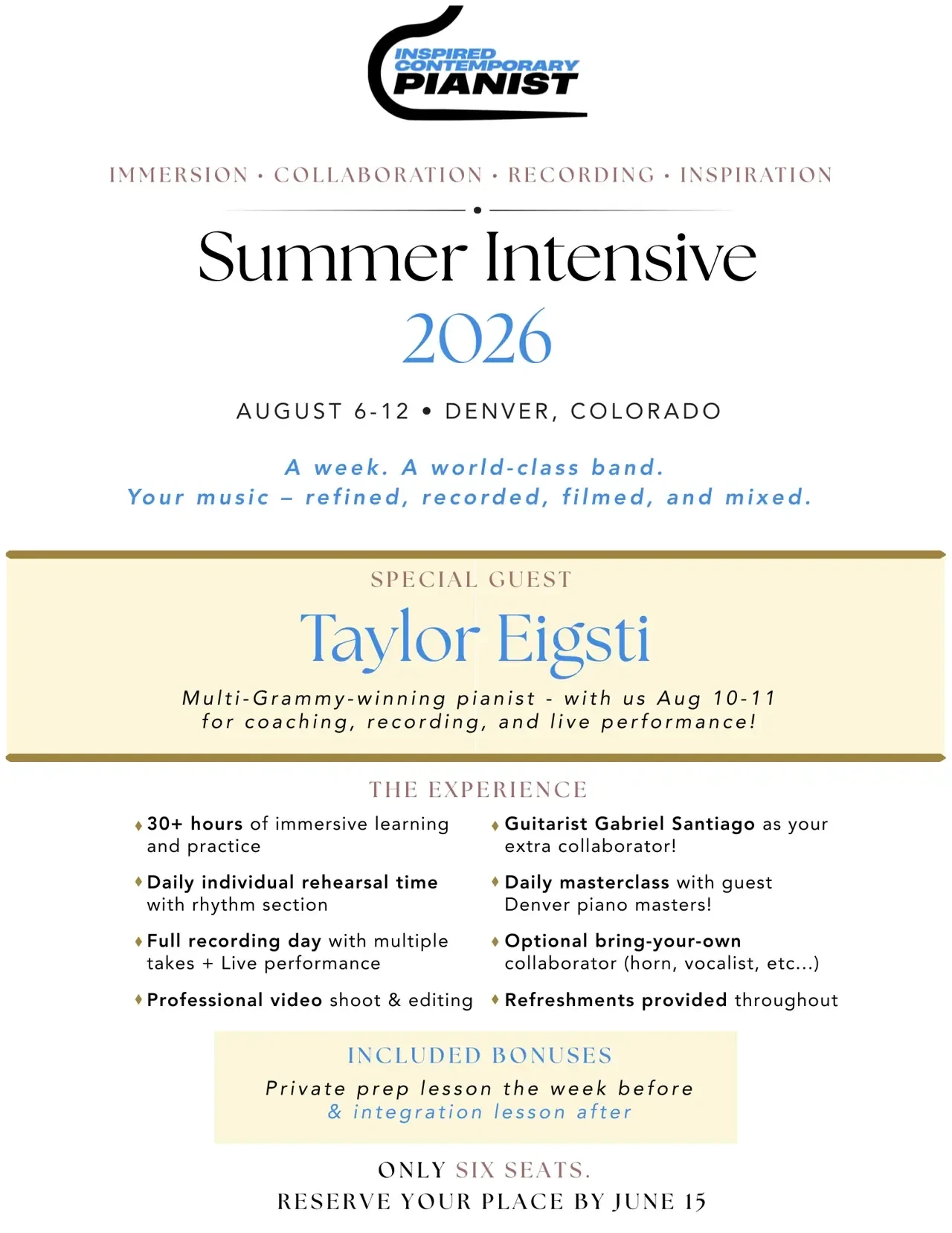
Summer Intensive in Denver!

Hello Inspired Pianists, I have been working on planning an incredible experience for our inaugural Summer Intensive. After the first outreach, it looks like we have three open spots left!
I've got 2 scholarship offers at 50% for folks who need it. Take a look at the flyer, and enjoy this video I put together with Taylor Eigsti highlights and my lesson for you.

@everyone If you are genuinely interested, comment here or message me directly.

Summer Intensive in Denver!

posted in

What Jazz Educators Get Wrong

Hi @everyone ,

I filmed this as a live session, but wanted to edit it a bit before posting.

I'll be interested to hear your responses -- very curious as to your relevant experiences learning, playing, and teaching.

What Jazz Educators Get Wrong — Session Summary

In this session, we explored a contemporary critique of jazz education through the lens of cognitive science, music learning research, improvisation, and real-world teaching experience. The central question was:

What actually helps people learn to improvise meaningfully, creatively, and joyfully?

The discussion focused on three major critiques of traditional jazz education, along with practical ideas for teaching and practicing in ways that better reflect the actual experience of expert improvisers.


1. “You Can’t Teach Creativity” — False

One of the major critiques explored in this session is the common belief that certain musical experiences “can’t be taught”:

  • creativity

  • imagination

  • interaction

  • expression

  • emotional communication

The session argues that while these things cannot be taught mechanically or identically to every student, they can absolutely be facilitated and developed intentionally.

Topics discussed:

  • Teaching students to connect feeling → sound

  • Facilitating listening awareness

  • Using motivic interaction to create conversation

  • Teaching strategic thinking instead of memorized formulas

  • Developing imagination through experimentation with:

    • rhythm

    • register

    • dynamics

    • permutation

    • variation

A key idea:

Anything that can be articulated, studied, and experimented on can be facilitated in teaching.


2. Theory as a Prerequisite vs. Experience as the Goal

A major theme of the session is the danger of overloading students with theoretical information before they’ve had meaningful musical experiences.

The argument:

  • Theory is important

  • Tools are important

  • But theory and tools are secondary

  • The primary goal is meaningful musical experience

Topics explored:

  • Why excessive prerequisite theory can overwhelm working memory

  • How “thinking note-to-note” blocks musical flow

  • Why students should experience successful improvisation early

  • Learning through “successful approximations” of expert experiences

  • Why even beginners can improvise musically with:

    • limited notes

    • space

    • groove

    • interaction

    • phrasing

Key concept:

The tools should serve the musical experience — not replace it.


3. Motivation, Confidence, and Learning Design

The session also examined how motivation and self-confidence are often misunderstood in jazz education.

Important ideas:

  • Early learners have lower resilience and confidence

  • Overwhelming students damages motivation

  • Teachers must carefully sequence activities to create meaningful success

  • “Success” should mean:

    • experiencing real musical communication

    • creativity

    • groove

    • expression

    • interaction
      —not just correct theory answers

This session emphasizes that students do not need master-level knowledge to experience authentic improvisation.


The Experience of Expertise

A major section of the session focused on what expert improvisers actually experience mentally while improvising.

Topics included:

  • Thinking in “big musical ideas”

  • Chunking information instead of calculating note-by-note

  • Pattern recognition and automaticity

  • Flow state and attentional capacity

  • Research from fMRI studies of jazz improvisers

  • Why expert improvisers often think conceptually rather than analytically in performance

The session explored how expert improvisers:

  • internalize technique deeply

  • automate fundamentals

  • free up mental bandwidth for:

    • expression

    • interaction

    • storytelling

    • emotional communication


Key Practice & Teaching Ideas

Some of the practical concepts discussed:

  • Teach through musical experiences first

  • Reduce cognitive overload

  • Practice in manageable “chunks”

  • Build automaticity gradually

  • Use constrained creativity exercises

  • Develop strategic thinking

  • Prioritize groove, phrasing, and interaction early

  • Help students experience success musically before overwhelming them theoretically


Central Themes of the Session

  • Jazz should be challenging and joyful

  • Improvisation is both:

    • an inner experience

    • an external skill

  • Effective teaching must address:

    • cognition

    • emotion

    • attention

    • creativity

    • motivation

  • Students learn best when they can meaningfully approximate the experience of real improvisers


Final Reflection

The session closes with an invitation for musicians and educators to reflect on moments when they experienced:

  • flow

  • creativity

  • interaction

  • deep listening

  • expressive freedom

  • joy in improvisation

Whether as advanced performers or beginners, the core idea is the same:

Effective jazz education should help people experience music meaningfully — not just accumulate information.

posted in

CO Show this Friday May 8th!

@everyone For my Colorado-based Inspired Pianists! I hope you'll come out for some live Democracy this Friday at the beautiful Muse Performance Space in Lafayette.
Doors at 6:30, show at 7pm.

Scroll to load more